Bellows Falls artists market themselves and their town, pandemic or not

Nearly 10 years ago a group of artists gathered at The Flat Iron Cafe in Bellows Falls, VT, intent on increasing the number of red dots that appear on the map of the annual statewide Memorial Day Open Studio Weekend tour sponsored by the Vermont Crafts Council.
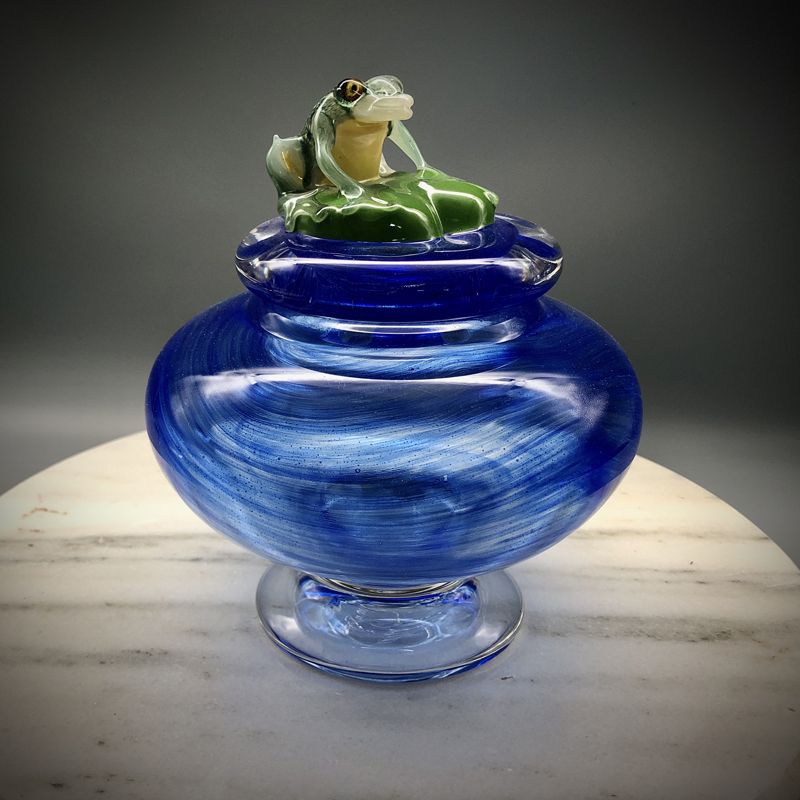
Blue swirl bowl with frog lid, by Chris Sherwin
The strategy was to create a cluster of red dots on the map in Bellows Falls to entice visitors to the town for Open Studio weekend. So the artists went to work to create a month-long series of events leading up to Open Studio Weekend to celebrate the arts in Bellows Falls. Special events included art-related movies at the Opera House, live music at “Stage 33”, a political event called “The Resistance” located at 33 Bridge Street, along with a series of exhibits around the village at several locations: The Flat Iron Cafe, Project Space 9 Gallery (Rockingham Arts & Museum Project) and the Canal Street Gallery. The cluster of red dots on the state tour map grew to represent individual artists, restaurants and arts centers.
The group known as the Koffee Klatch, and has been gaining momentum, despite and because of the pandemic.
The arrival of COVID 19 and the subsequent shut down interrupted not only the group’s plans for last year’s May Art Month in Bellows Falls, but the camaraderie that the group had come to depend on from their monthly meetings waned. Many work other jobs to pay the bills. Some lost their jobs or hours were cut.
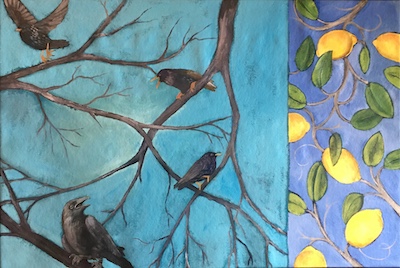
The Caw, by Jeanette Staley
Soon however it became clear that the Koffee Klatch provided vital connection and support for the artists. Monthly meetings resumed and became more valuable, even urgent–a necessity for morale if nothing else, and so continued on Zoom. Attention shifted from the red dots on a map once a year, to “how to survive as an artist in a village in Vermont during a pandemic”– a heavy lift.
“As artists, studio work provides space and catharsis for processing the societal effects the pandemic has exposed, and subsequent losses, but also is serves to reimagine what is possible,” says, Jeanette Staley, a member of the group.
Brattleboro penthouse reflects a couple’s love of African and Cuban cultures
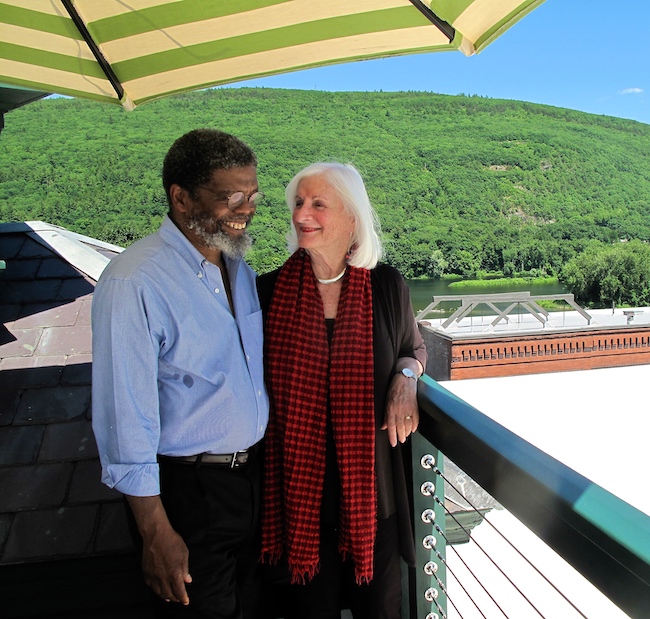
Curtiss Reed, Jr. and Cathryn Griffith on the balcony of their downtown Brattleboro apartment, overlooking the Connecticut River and Mt. Wantastiquet.
By Joyce Marcel
Couples love to tell the story of how they met, but Curtiss Reed, Jr. and Cathryn Griffith have a love story that has three origins, not just one.
The first was in Aix en Provence, France, in 1986, when the two attended the same degree program at the same time — but somehow never met.
“I was a widow with a 12-year-old daughter,” Griffith said, laughing at the memory. “He said he would not have been interested in me.”
After not meeting in Aix, these sophisticated and well-travelled people moved on with their interesting and independent lives. Griffith, who is white, began a successful career as a commercial real estate developer in Boston. She also became an art photographer who, in 2010, had her photographs of Cuban architecture — matched with her collection of antique postcards of the same buildings — turned into a lovely coffee table book. And the aforementioned daughter, now grown, has made Griffith a grandmother three times over.
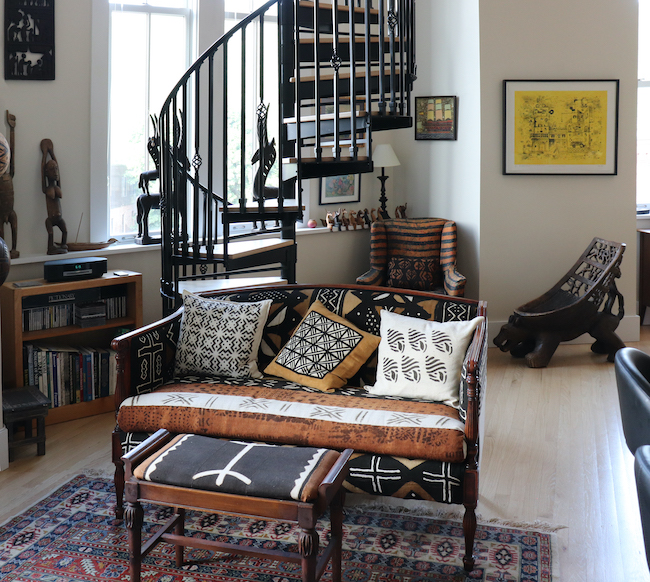
Interior view of the apartment, including spiral stairs to the tower room. The love seat features Bogolan cloth from Mali and pillowcases from Ghana and Mali. The yellow painting is by Cuban artist Luiz Rodriguez Noa, who personalized it by labeling “Curtiss” in the picture.
Reed, who is Black, is the divorced father of three children, who are all in their 20s. He spent 18 years in Africa, beginning as a Peace Corps volunteer in Tunisia in March of 1993. There he fell in love with life overseas and made a career of it, working for the National Cooperative Business Organization training cooperative management trainers in French speaking and Portuguese-speaking Africa. Then he spent four years doing the same with Africare.
Brattleboro’s Retreat Farm: A place like no other, during a time like no other
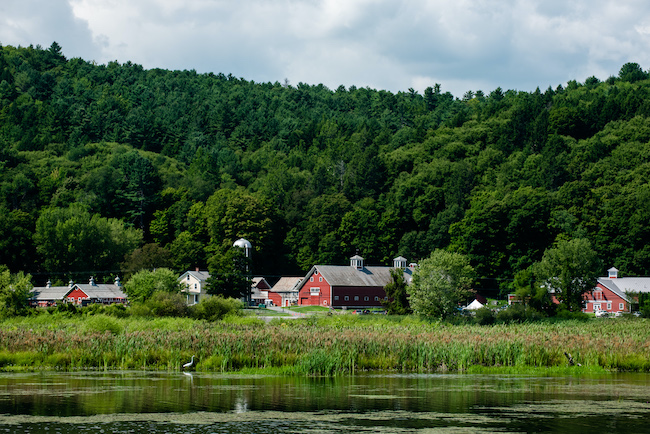
Right now, we all need a place to get away and unplug. Open space to run free, homelands to ground us, water views to rejuvenate our spirits. Filled with places to explore, learn, and unwind, Retreat Farm’s expansive property is open and free to everyone.
“In this difficult year, we know that spending time in nature and on our beautiful property can help improve people’s physical, mental, and spiritual health. Retreat Farm is committed to making these experiences available to everyone this year through free membership and access to the Farm,” said Buzz Schmidt, Executive Director of Retreat Farm.
In addition to animals grazing on pasture and growing food to share with the community, the Farm has added a new labyrinth garden, arts installations, walking paths and trails, and interpretive signs about the history and nature of the property. Works by local artists Bob Boemig and Steve Proctor are yours to savor, with a sculpture by Miles Chapin and a tribute to Wolf Kahn and Emily Mason coming soon.
Venture through the historic cow tunnel under Route 30, wind through the pollinator pathway to the new Meadows waterfront trail, play, build and balance in the Forest Playground, walk along Lil’ Lamb Loop as rotating children’s books unfold on the Storybook Walk, or discover natural history lessons on the Woodlands Interpretive trail.
Bring a picnic and soak up the views of the new living sculpture, the Fiddlehead, or the unique ambiance of Farmhouse Square as you relax and learn about the history of the 19th-century farmstead. After its installation in mid August, don’t miss the Wantastegok marker at the entrance to the Meadows, where you can learn more about the current and historical significance of this site to the Abenaki people.
A Vermont community helps asylum seekers one family at a time

By Elaine Clift
“They are not European immigrants celebrated at Ellis Island, but they are our continent’s immigrants, here, now. I don’t have a lamp, and there is no golden door, but I lift my eyes to meet them, to see them, and to say, Welcome.”
Those words uttered by Steve Crofter, founder of the Community Asylum Seekers Project (CASP) in Windham County, Vermont, speak volumes about the mission of a volunteer-driven organization begun four years ago to provide basic needs and support for people in the process of seeking asylum in the U.S.
 Crofter was motivated to start CASP when he volunteered with asylum seekers in Texas in 2015. “My favorite place to help was at the showers. Often tears ran down my cheeks. I was so aware of the humanity and the individuality of the people who came to this rest stop.” Among them were a father who had to leave his son behind and a mother who gave her 12-year old daughter birth control pills assuming she would be raped on their journey.
A year later, CASP formed as a non-profit organization and began creating living space for an asylum-seeking family, aided by supportive community members who contributed labor and funding in Crofter’s Vermont community. In 2017 the first asylum seeking family was welcomed by CASP, the Board received training on refugees and immigration, and a volunteer case manager was hired. By 2019 a sixth family had arrived, two part time staff were hired, and volunteers received that year’s Unsung Heroes Award from Compassionate Brattleboro.
Today CASP still finds local homes for individuals and families, supports their daily needs, and offers legal guidance as guests navigate the asylum claim process. To date a cadre of volunteers and two staff, guided by a seven-person Board, have helped, and hosted, seventeen adults and children, mainly from Latin America. Currently, six guests are working, seven live independently, and two families have moved to other states. A four-year old child was reunited with her mother after two years apart and two other children were reunited with their mothers.
Sunny forecast For Dutton’s Berry Farm
By Karen J. Irvine
One of the most significant food trends to emerge over the last two decades has been the increased demand for locally grown food products. Whether to insure quality, or to reduce carbon footprints, or simply to enjoy the freshest items available, consumers increasingly have been turning to small, local farms for staples like produce, breads, meat, eggs and dairy.
_____________________________
… and much more:
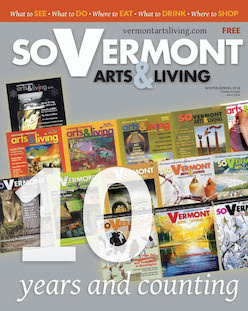
And here’s a sampling of stories from recent issues you might enjoy! (Also, check out ALL of our past issues, using the “Past Issues” tab in our top menu bar.)
Upfront:
Redeveloping Bennington’s Putnam Block
BMAC plans for ambitious growth
A happy coworking hub comes to Bennington
Bookmarks: Vermont’s Wild-Haired Political Icon
A story in itself: How Everyone’s Books took on the establishment — and won
The Stone Trust: A lost art blossoms in Dummerston
Features
Insider: Windham County at Its Heart — ‘Southern Vermont is like a matryoshka doll: there is always more to appreciate beneath the surface.’
Their Little Corner — Rescue of a historic wreck kindles a couple’s love.
Lasting Impact: Exhibits trace Vermont’s counterculture ever forward
Putting the national movement of the 60s in local context through photography, puppetry, clothing, art, and text.
Insider: On covered bridges, trout streams, and becoming a Vermonter
Our farms: The Happy Cows of Jersey Girls Dairy
Lisa Kaiman’s farming philosophy is rooted in an excellent quality of life for her cows.
Entrepreneurs: Fueled by Nature
Artist Laura Zindel is ‘enamored of the flora and fauna of this world’ — and celebrates it with a thriving business of beautiful and functional earthenware.
Entrepreneurs: Publisher on a Mission
The award-winning Green Writers Press represents the intersection of Dede Cummings’ passions for the published word and a sustainable future for the Earth.
The Art of Craft in a Digital World
Might it be that the more we digitize the more we risk losing what’s human?
Arts & Couples: Double Vision
DaVallia Art & Accents rocks a decade.
Vermont Entrepreneurs:
Charting Their Own Course
These Vermont entrepreneurs mean business.
Farm couples: Following a dream
Ashlyn Bristle and Abraham McClurg farm like they mean it.
Insiders: Welcome to the Deerfield Valley
Four decades after she first set foot here, Janet L. Boyd still finds something to celebrate every season.
Vermont Food & drink
Express Yourself — Wedding menu planning catches up with the times.
A Taste Like No Other — Maple syrup’s flavor is unique and complex in its pure form. Now, enterprising Vermont farmers are crafting infusions of new flavors, from smoked chili to pumpkin spice. Plus: Maple Miscellany.
Layers of Interest: Chocolatier of Vermont
Take yourself on a journey and meet chocolatiers whose sweet creations are distinctly Vermont.
Recipe: Chocolate Pâté
A seasonal treat.